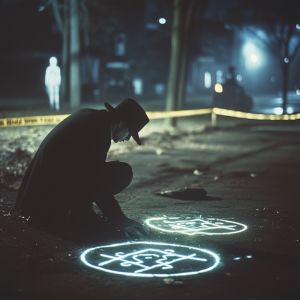
The supernatural has fascinated humans for centuries, but in an age of science and technology, can we explain myths and magic using rational thought? While many supernatural experiences seem beyond logic, science often offers intriguing theories that blur the line between the mystical and the explainable.
The Psychology of Paranormal Experiences
Many supernatural encounters—ghost sightings, demonic possessions, and near-death experiences—can be linked to psychology. Sleep paralysis, for example, explains many “demonic” encounters, while heightened emotions and fear can create hallucinations that seem supernatural. The human brain is wired to find patterns, which may contribute to seeing ghosts where none exist.
Energy, Vibrations, and the Science of Magic
Could magic be a form of unseen energy? Quantum physics explores concepts like energy transfer, parallel dimensions, and particle entanglement, leading some to speculate that “magic” could simply be science we don’t yet understand. Many mystical traditions focus on vibrations and frequencies, concepts that science is beginning to study more closely.
Ancient Myths and Misunderstood Science
Throughout history, what we now consider science was once seen as magic. Alchemy evolved into chemistry, astrology influenced early astronomy, and herbal medicine formed the foundation of modern pharmacology. Many ancient myths may be exaggerated retellings of natural phenomena—lightning as Zeus’s wrath, earthquakes as a giant shifting underground.
The Paranormal and Multiverse Theories
Modern physics explores the possibility of multiple dimensions, which could explain ghostly apparitions, déjà vu, or unexplained disappearances. If alternate realities exist alongside our own, it’s possible that supernatural encounters are simply brief glimpses into another world.
While science can explain many supernatural occurrences, some mysteries remain unsolved. Whether magic is real or simply undiscovered science, the intersection of myth and logic keeps us questioning what’s truly possible.